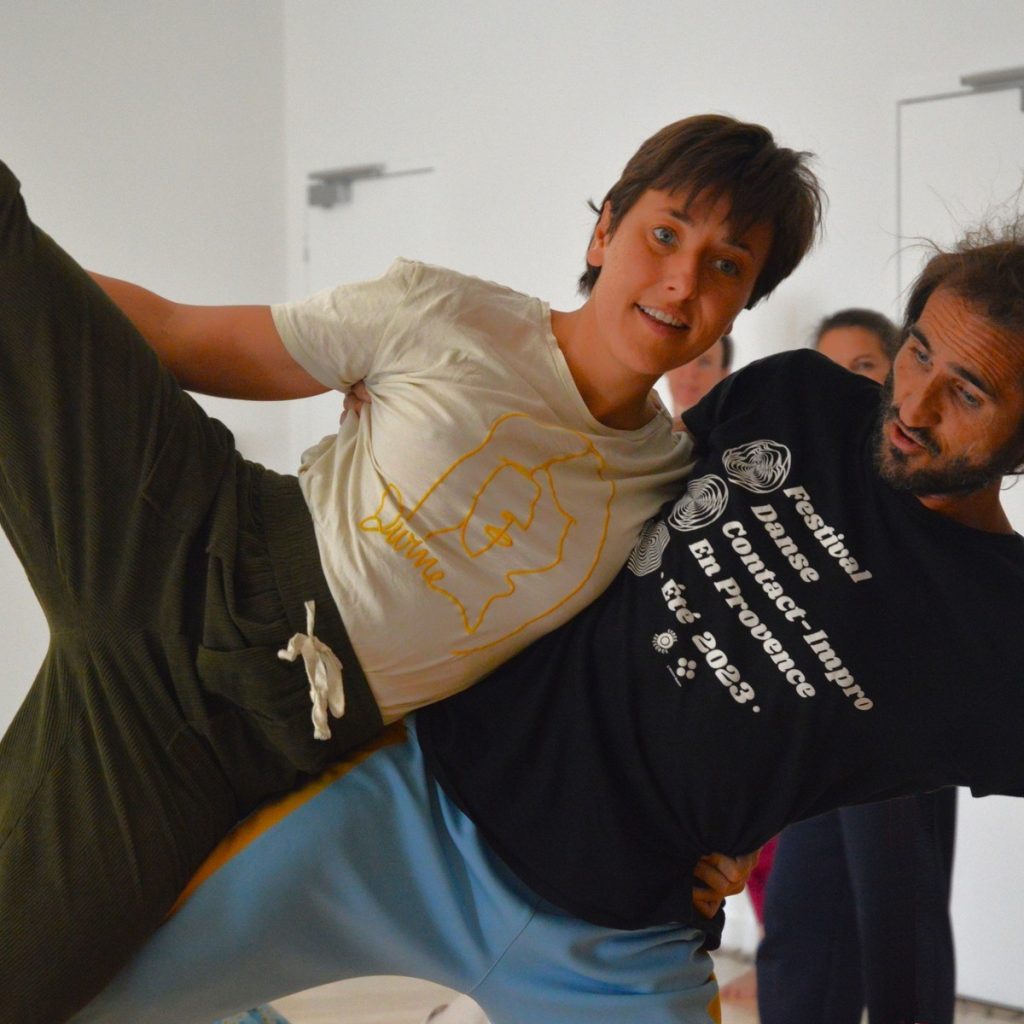
Workshops & Intensives
Long intense teaching formats that can fit into multi-day festivals or weekend intensives, where we dive deep into the practice of Contact Improvisation. Designed and adaptable for all levels, from beginners to experienced dancers. These sessions offer a unique space to connect with others, explore new movement possibilities, and refine techniques. Through immersive learning, we focus on understanding movement principles and improvisational skills, making these experiences perfect for anyone looking to deepen their practice and engage more fully with Contact Improvisation.
My Teaching Focus in Contact Improvisation
In my Contact Improvisation classes, I invite dancers into a space of physical research, embodied presence, and relational awareness. My work is grounded in a deep fascination for gravity, momentum, and the intelligence of a body that listens — to itself, to the floor, and to other bodies.

A central focus is exploring physicality through gravity and momentum. We work with falling, rolling, spiraling, and yielding, learning to let gravity guide us instead of resisting it. This approach brings efficiency, fluidity, and groundedness, allowing dancers to discover movement that is both powerful and effortless. Through this process, we explore how momentum can be harnessed as a creative partner, shaping pathways and transitions.

Another essential aspect is receiving and offering weight with clarity, precision, and care. We cultivate sharp states of awareness, where touch becomes a form of listening. Weight-sharing is approached as a dialogue — a continuous exchange of information, intention, and responsiveness. This practice enhances relational sensitivity and builds trust, allowing dancers to move together with safety, openness, and curiosity.

I am also deeply interested in presence — the capacity to inhabit stillness and movement with equal attention. In stillness, we perceive the subtle shifts beneath the surface; in movement, we maintain an inner spaciousness from which choices arise. Presence becomes the bridge between intuition and technique, between individuality and connection.

A fundamental part of my approach is nurturing the research mindset. I encourage dancers to cultivate curiosity, to question through the body, and to explore without the need for predetermined outcomes. This mindset empowers dancers to become active creators rather than passive movers, expanding their sense of agency and imagination.

As transversal elements, my teaching integrates pleasure, consent, boundaries, poetry, and community. Pleasure keeps the practice joyful and sustainable; consent and boundaries create clarity and safety; poetry brings sensitivity and inspiration; and community supports a shared sense of exploration.
Ultimately, my classes aim to empower dancers to explore movement, relationship, and creativity with courage, listening, and a strong sense of embodied presence — cultivating not only technical skill, but also a deeper capacity to be moved, with oneself and with others.
Some focus Workshops
In my ongoing journey with Contact Improvisation (CI), as dancer, researcher and teacher, I’ve identified a few subjects that are of my particular interest, and that I find also essential to understanding the mechanics and artistic potential of CI. Below, I share some examples of these subjects, offering a glimpse into the insights and techniques I explore and develop through my teachings.
Falling
Safely exploration of falling, meeting the ground with control. Through warm-ups, joint softening, and partnered exercises, participants build confidence, learning to trust their bodies’ natural intelligence and find momentum for a «flying» sensation.
Flying
Introduces safe lifting and being lifted by exploring momentum and taking advantatge of our natural body weight. Participants learn to trust the fall and use flow rather than strength, protecting joints and muscles. Through guided partner exercises, dancers experience the lightness and freedom of «flying» with ease and support.
Weight Sharing Continuum
Exploration of the dynamic exchange of weight in movement, helping dancers develop trust and adaptability with a partner. Through grounding exercises, body listening, and balance exploration, participants find fluid pathways for shifting support, creating an intuitive flow between giving and receiving weight in motion.
Playing with Manipulation
delves into guiding, redirecting, and shaping a partner’s movement with subtlety and sensitivity. Through exercises in balance, timing, and resistance, participants learn how to respectfully influence one another’s motion, building trust, body awareness, and a responsive dialogue that deepens the improvisational connection.
Our Back Space
Engaging with the lesser-used areas behind the body. Through exercises that build awareness and confidence, participants learn to navigate backward, releasing fear and embracing trust in these unseen spaces, expanding both physical range and comfort in movement partnerships.
On Following and Leading
Exploration of the dynamic roles of guide and responder in dance. Through exercises that shift between leading and following, dancers become attuned to subtle cues, developing trust and awareness. The practice emphasizes presence, adaptability, and responsiveness within the shared improvisational flow.